
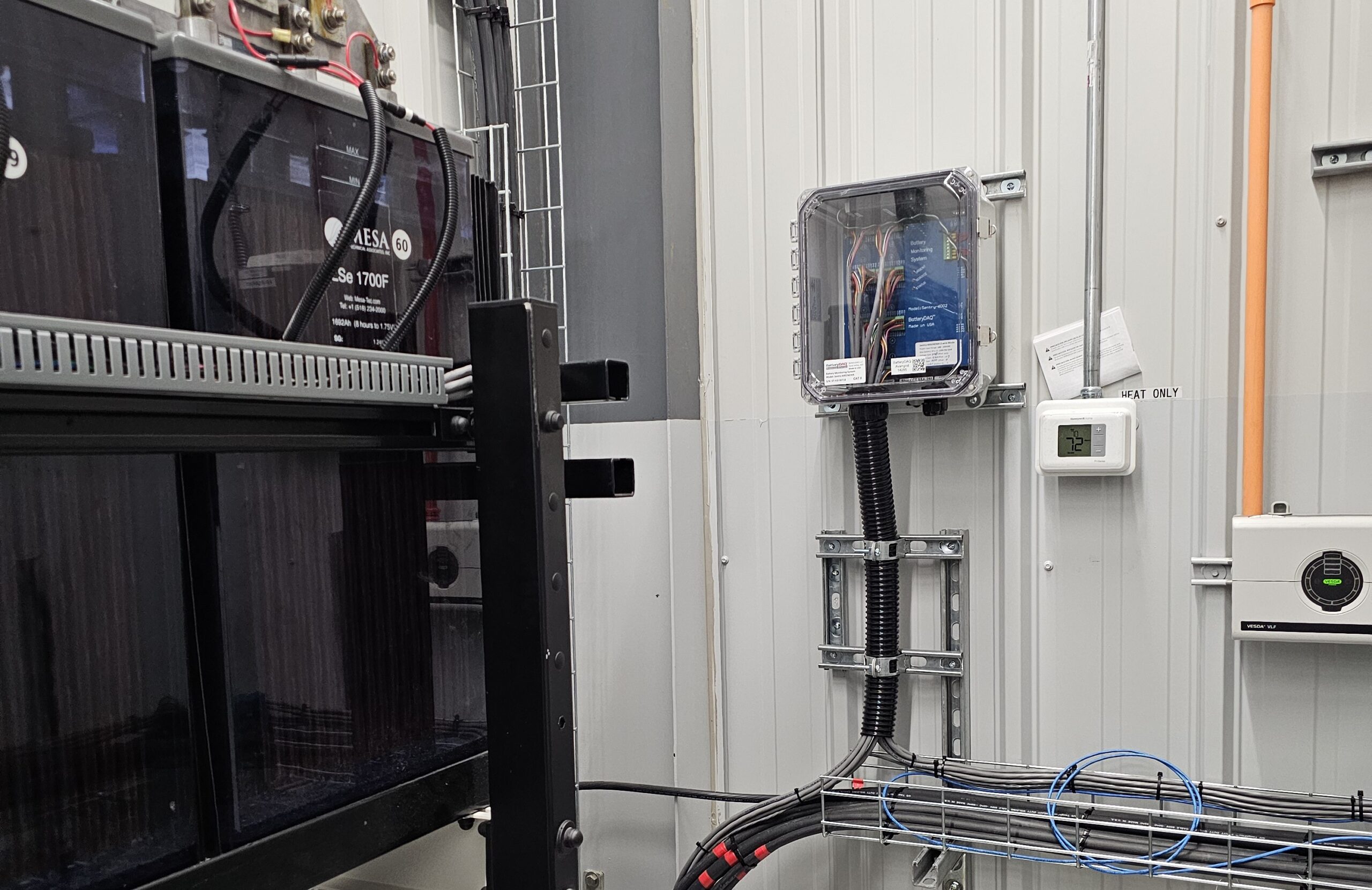
Reliable Battery Monitoring, Maintenance Tracking, and Reporting for Power Plants and Substations
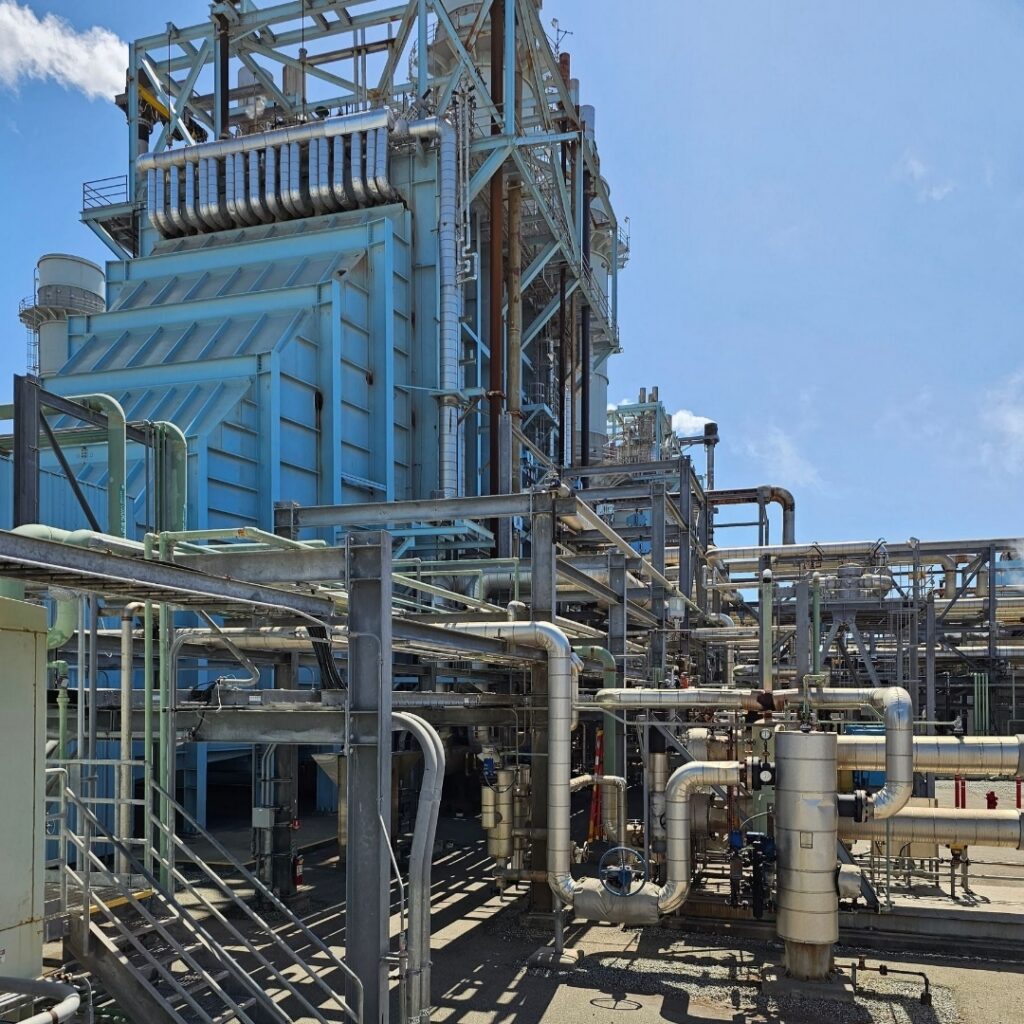
Stationary batteries are a critical part of the DC power system in power plants and substations. They provide reliable DC power when AC power is lost and supply the high transient current required by critical DC loads, such as switchgear operation and starting LO (Lubrication Oil) pumps. The station DC system supports protective relays, breakers, controls, communications, and other critical equipment.
NERC PRC-005 establishes maintenance requirements for Protection Systems, including applicable station DC supplies and batteries.
BatteryDAQ provides battery monitoring systems designed specifically for stationary battery applications, helping utilities:
- Automate battery measurements required for maintenance programs
- Identify battery and connection problems before they become failures
- Reduce manual testing and unnecessary site visits
- Maintain historical data and maintenance records
- Generate consistent NERC reports
- Integrate battery information with SCADA and enterprise systems
- Support long-term, auditable battery maintenance programs

NERC PRC-005 Battery Maintenance Checklist
NERC PRC-005-6 includes specific requirements for station DC supplies using Vented Lead-Acid (VLA), Valve-Regulated Lead-Acid (VRLA), and Nickel-Cadmium (NiCad) batteries.
For VLA batteries without the applicable monitoring attributes of Table 1-4(f), Table 1-4(a) specifies activities including station DC supply voltage verification, electrolyte-level inspection, inspection for unintentional grounds, charger float-voltage verification, battery continuity, terminal and intercell connection resistance, cell condition, and battery-rack condition.
For VRLA batteries, PRC-005-6 also specifies periodic internal-ohmic measurements or other applicable performance verification.
Typical NERC Battery Checklist
| Maintenance Item | BatteryDAQ Support |
| Station DC supply / string voltage | ☑ Continuous monitoring and alarming |
| Individual cell/unit voltage | ☑ Continuous monitoring |
| Charger float voltage | ☑ Monitoring and alarming |
| Battery continuity | ☑ Automatic monitoring and alarming |
| Battery terminal connection resistance | ☑ Automatic resistance measurement |
| Intercell / unit-to-unit connection resistance | ☑ Automatic resistance measurement |
| Cell/unit internal ohmic value | ☑ Automatic DC internal resistance measurement |
| Unintentional DC ground | ☑ Ground-fault monitoring option |
| Electrolyte level | ☑ Inspection tracking and ELM options |
| Battery condition | ☑ Historical measurements, alarms and trending |
| Battery rack condition | ☑ Periodic physical inspection / maintenance record |
| Battery discharge performance | ☑ Automatic discharge capture and historical records |
| Maintenance evidence | ☑ NERC reports and historical database |
The exact maintenance program depends on battery chemistry, system configuration, installed monitoring, and the utility’s compliance program. Users should refer to the current NERC standard and their organization’s compliance requirements when establishing maintenance procedures.
How Continuous Battery Monitoring Can Reduce Periodic Maintenance
PRC-005-6 Table 1-4(f), “Exclusions for Protection System Station dc Supply Monitoring Devices and Systems,” recognizes that specific periodic maintenance activities are not required when the corresponding monitoring and alarming attributes are provided.
These attributes include monitoring and alarming for:
- High and low station DC supply voltage
- Electrolyte level in every cell, when this exclusion is used
- Unintentional DC grounds
- Charger float voltage
- Battery string continuity
- Intercell and/or terminal connection resistance
- Cell/unit internal ohmic values
- Evaluation of internal ohmic values relative to battery baseline
For the qualifying attributes listed in Table 1-4(f), NERC specifies “No periodic maintenance specified” for the corresponding maintenance activities.
This is one of the major advantages of a properly designed online battery monitoring system: maintenance can become increasingly condition-based and data-driven, rather than relying only on periodic manual measurements.
However, installing a battery monitor does not automatically eliminate every inspection or maintenance activity. The monitoring system must provide the applicable monitoring and alarming functions, and utilities must establish their maintenance programs accordingly.
BatteryDAQ Solutions for NERC PRC-005
BatteryDAQ battery monitoring systems are purpose-built for stationary batteries in utility applications.
Unlike a general-purpose data acquisition system, BatteryDAQ monitors the electrical characteristics that reveal the condition of the battery, its connections, and the complete DC supply.
Cell Voltage Monitoring
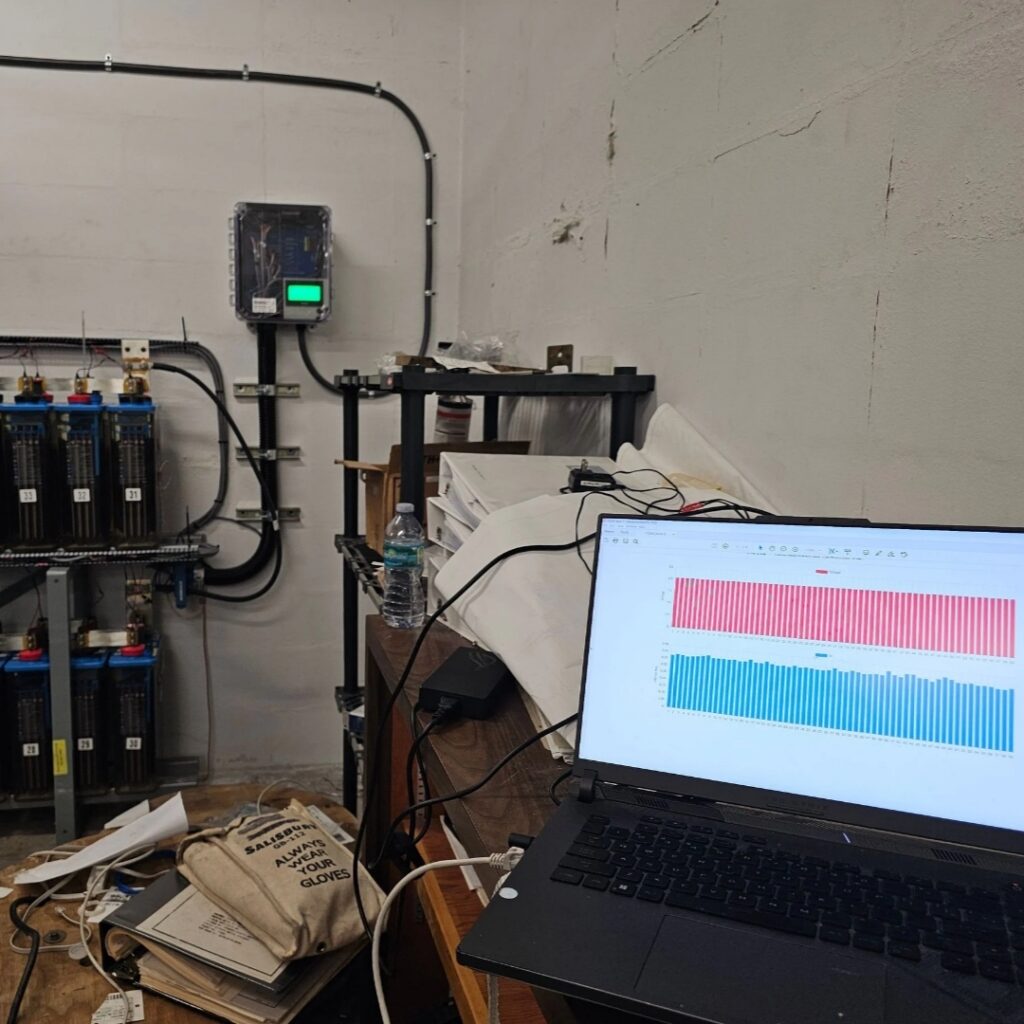
Individual cell or unit voltage is continuously measured so abnormal cells can be identified before they compromise the battery string.
During a discharge, BatteryDAQ automatically captures cell-level voltage data, making it possible to identify weak cells that may not be apparent from overall string voltage alone.
Internal Resistance Monitoring
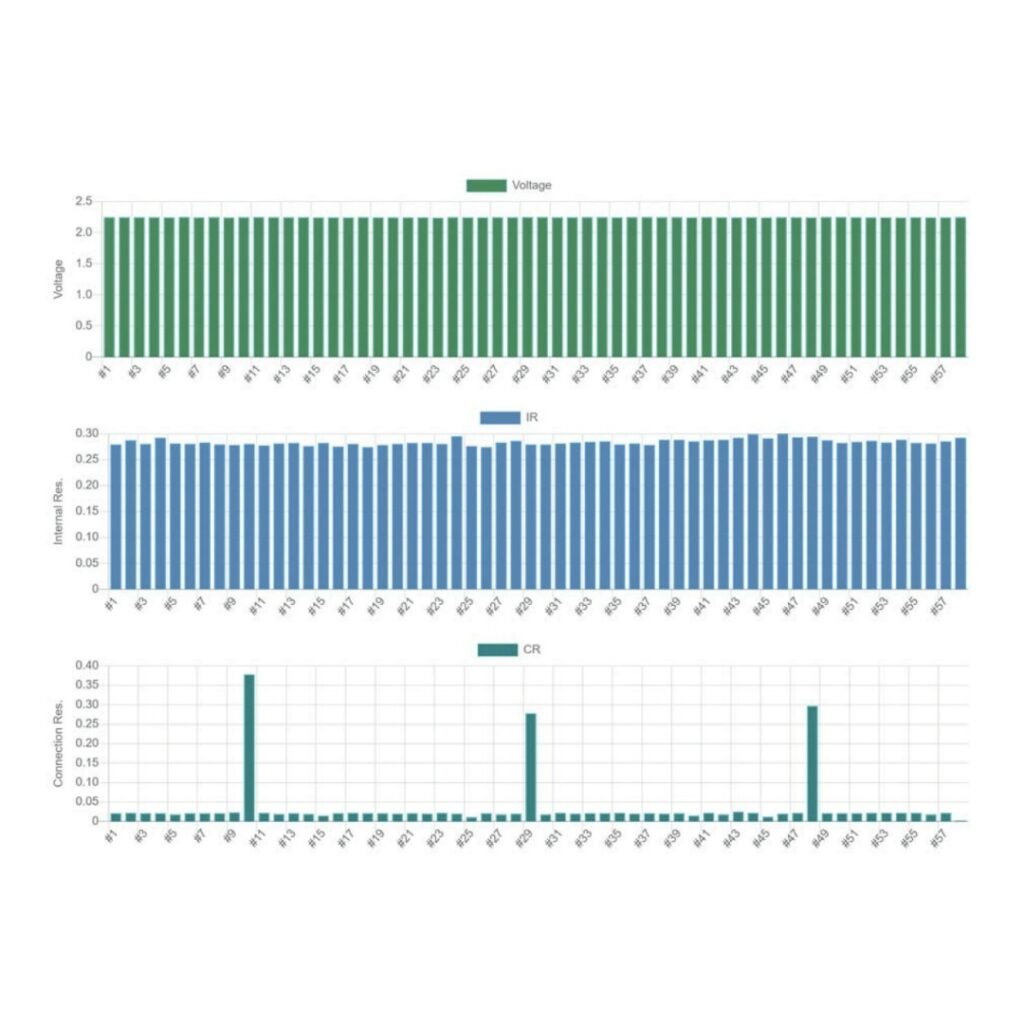
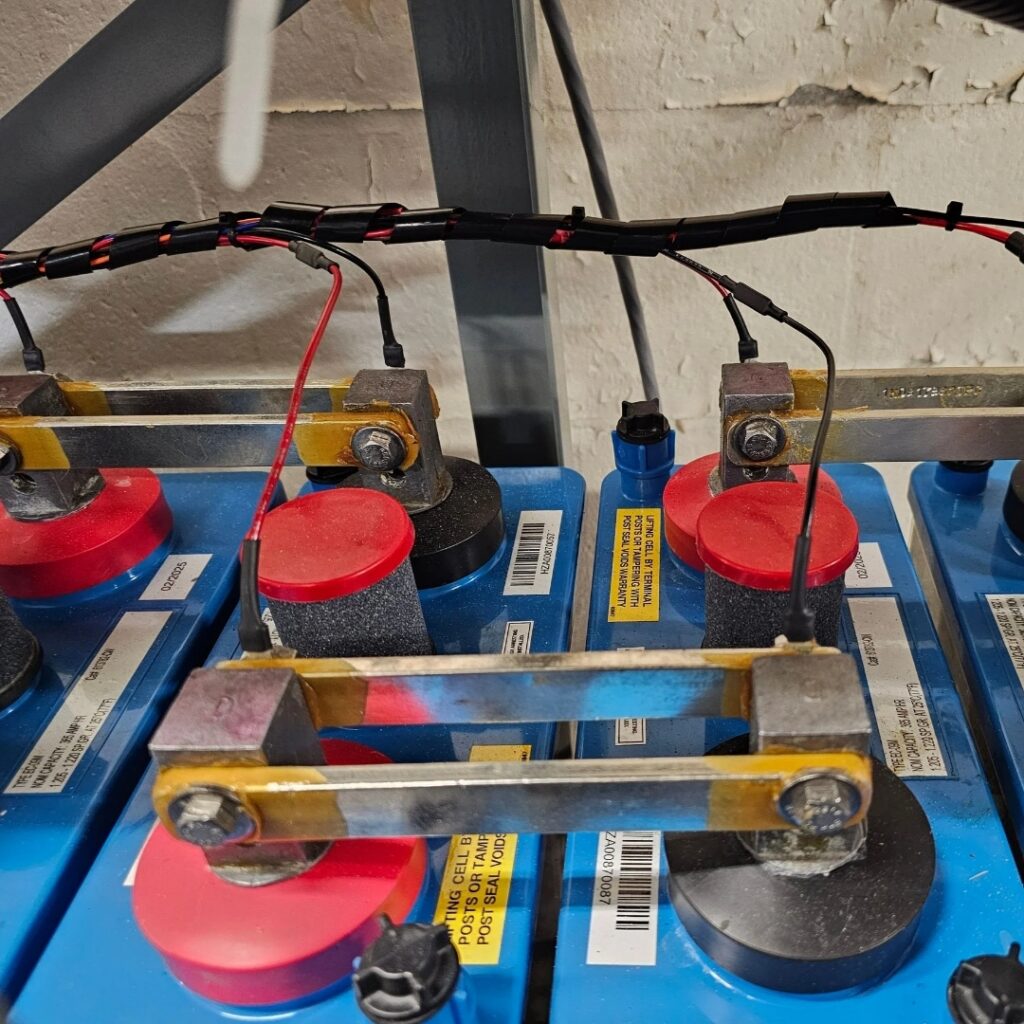
BatteryDAQ automatically measures the internal resistance of every monitored cell or unit.
Internal resistance provides an important indication of battery condition and allows present measurements to be compared with baseline and historical values.
Rather than relying only on a periodic handheld measurement, BatteryDAQ creates a long-term history for each cell.
See the trend—not just today’s measurement.
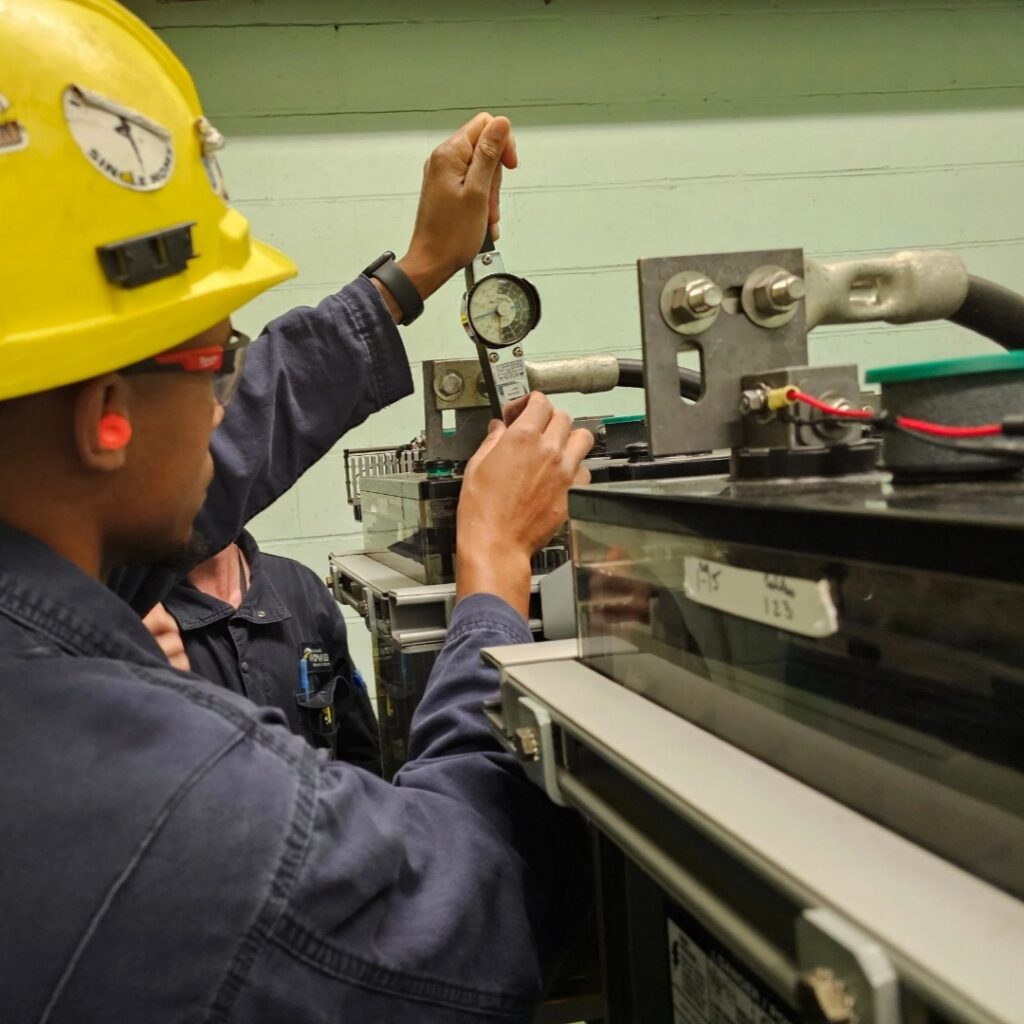
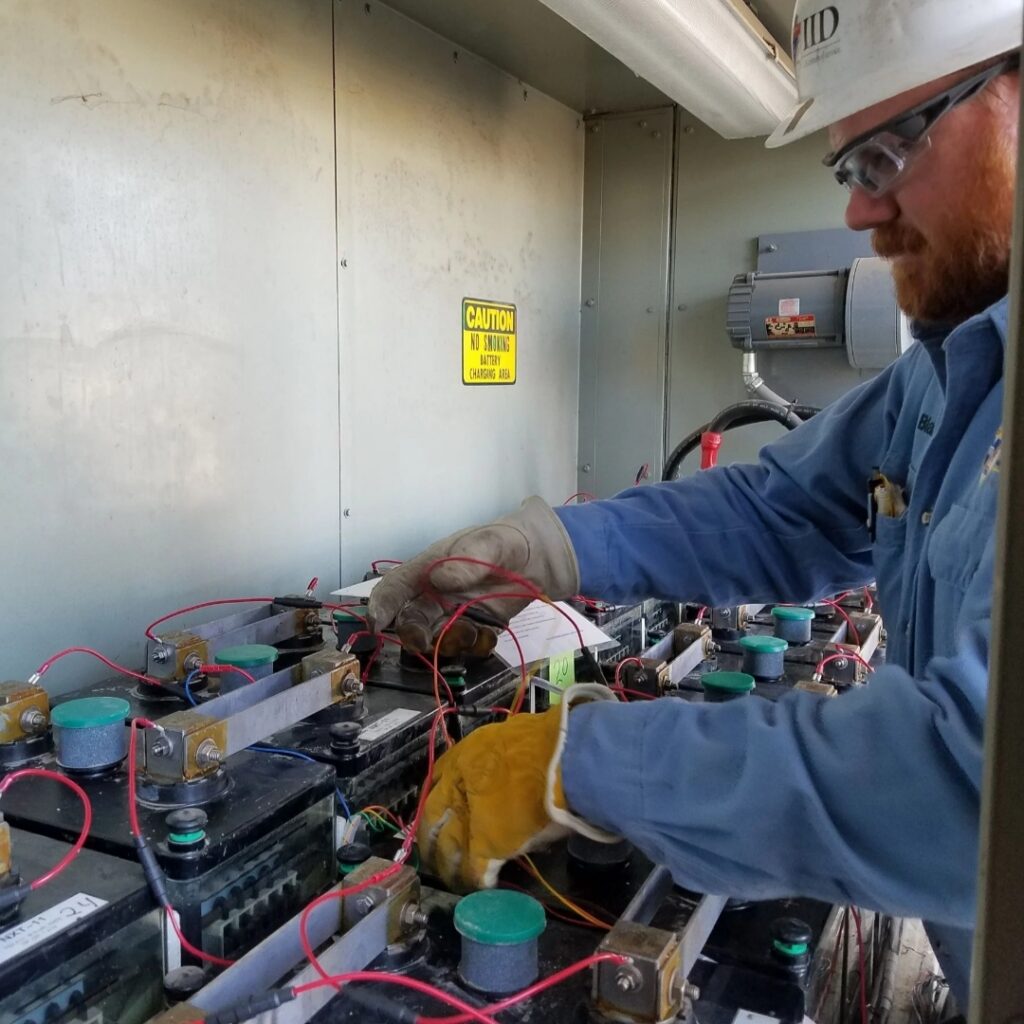
Intercell and Terminal Connection Resistance
A battery is only as reliable as its connections.
Loose, corroded, or deteriorating connections can create excessive resistance and heating and can ultimately prevent the station battery from delivering the current required during an emergency.
BatteryDAQ monitors very low connection resistance at the micro-ohm level, including:
- Intercell connections
- Inter-tier connections
- Battery terminal connections
Historical trending helps maintenance personnel identify gradual deterioration before it becomes a critical problem.


Electrolyte Level: Monitoring or Inspection Tracking
For vented batteries, electrolyte level is an important part of PRC-005 maintenance.
PRC-005-6 Table 1-4(f) allows periodic electrolyte-level inspection to be eliminated when every cell is equipped with electrolyte-level monitoring and alarming.
However, continuous Electrolyte Level Monitoring (ELM) is not always the best approach for every installation.
BatteryDAQ supports two approaches:
Electrolyte Level Monitoring
Where appropriate, electrolyte-level sensors can provide continuous monitoring and alarms.
Electrolyte Inspection and Water-Topping Tracking
For utilities that prefer periodic visual inspection, BatteryDAQ can track:
- Required electrolyte inspection dates
- Inspection completion
- Cells requiring water
- Water-topping completion
- Maintenance history
This provides a practical electronic record of the inspection and maintenance process while avoiding dependence on an electrolyte sensor where continuous ELM is not desired.
Automatic Discharge Capture
The most important moment for a station battery is when it is actually called upon to perform.
BatteryDAQ automatically detects battery discharge events and records:
- String voltage
- Individual cell/unit voltage
- Discharge current
- Cell behavior throughout the event
- Minimum values and abnormal cells
This transforms an actual outage or breaker operation into valuable battery-performance information.
Instead of knowing only that the battery discharged, engineers can review how every cell performed during the event.
NERC Reporting and Historical Data
Compliance requires more than collecting measurements.
The data must remain accessible, understandable, and useful as maintenance evidence.
BatteryDAQ maintains historical battery data and provides reporting designed to support NERC PRC-005 maintenance programs.
Reports can include:
- Station and battery identification
- Cell/unit voltage
- Internal resistance
- Intercell connection resistance
- Terminal connection resistance
- String voltage
- Temperature
- Ground-fault status
- Alarm status
- Electrolyte inspection records
- Water-topping records
- Historical trends
Long-term trending also allows engineers to compare individual cells, identify deterioration rates, and plan maintenance based on actual battery condition.
From One Battery to an Enterprise Battery Fleet
A battery monitor at an individual substation solves only part of the problem.
Utilities may operate hundreds or thousands of stationary batteries across substations, generation facilities, and other critical sites.
BatteryDAQ supports centralized battery management so engineering and maintenance teams can view the condition of their battery fleet from one location.
Local Monitoring
Each BatteryDAQ system can operate independently at the site and maintain local measurements and historical data.
SCADA Integration
BatteryDAQ supports common utility communication protocols for integration with existing systems, including:
- DNP3 (Verified with RTAC, PI Vision and multiple software)
- Modbus TCP, Modbus RTU
- API, SNMP
- Alarm dry-contact output
- Customized data packet for integration with existing asset management software
Enterprise Monitoring
BatteryDAQ enterprise software can consolidate information from multiple sites for:
- Fleet-wide battery status
- Centralized alarming
- Historical trending
- NERC reporting
- Asset management
- Maintenance planning
IT Security Matters
Battery monitoring systems installed in substations and power plants are increasingly connected to utility networks.
A monitoring system therefore needs to be designed not only for accurate measurements, but also for integration into modern utility IT and cybersecurity environments.
BatteryDAQ systems are designed with utility network requirements in mind.
No Cloud Connection Required
Battery monitoring and historical data can remain entirely within the utility’s network.
No external cloud service is required for normal system operation.
No Wi-Fi or Bluetooth Required
For critical utility applications, BatteryDAQ uses wired communications and does not depend on consumer wireless technologies for normal monitoring.
both Local and centralized Data Storage
Battery data can be maintained locally at the site, providing continued monitoring and historical recording even when the enterprise network is unavailable.
Enterprise Network Integration
For larger deployments, BatteryDAQ supports centralized servers within the utility’s own network infrastructure.
Enterprise implementations can support integration with existing IT security policies and Microsoft AD (Active Directory) environments/user control.
SCADA Integration
Battery alarms and measurements can be integrated with existing SCADA architectures rather than requiring operators to depend on a separate cloud portal.
Reliability Is More Than a Datasheet Specification
A battery monitoring system may remain in service for 15 or 20 years.
For power plants and substations, reliability therefore needs to be considered from the beginning of the product design.
BatteryDAQ systems are engineered for long-term stationary battery monitoring.
Designed for the Battery Environment
Battery rooms can expose electronics to temperature variation, corrosive environments, and electrical transients.
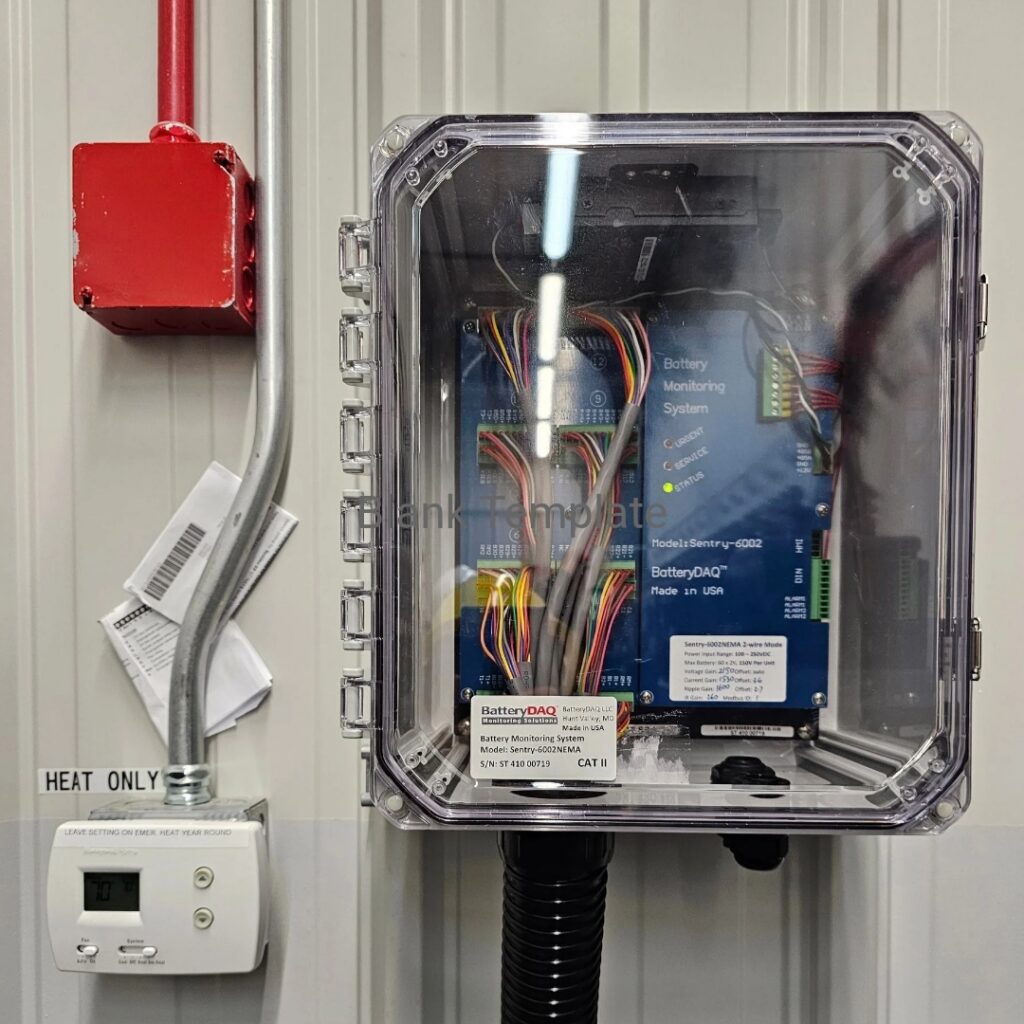
BatteryDAQ offers sealed monitoring systems designed for both indoor and outdoor utility installations.
Temperature Tested
BatteryDAQ BMS systems are tested in a temperature chamber across their specified operating range of:
-30°C to +65°C (-22°F to +149°F)
This is particularly important when monitoring equipment is installed outside the conditioned battery room or when ventilation or cooling is lost.
Proven in Utility Service
BatteryDAQ systems (1,000+) have been operating in power plants and substations for many years, continuously collecting battery data and supporting utility maintenance programs.
Hardware longevity also matters when software evolves. BatteryDAQ’s approach is to maintain compatibility wherever practical so existing installations can benefit from improved trending, reporting, and NERC functionality without unnecessary hardware replacement.

Reliability is not theoretical. It is engineered, tested, and proven in service.
A Data-Driven Approach to Battery Maintenance
The objective of NERC PRC-005 is not simply to collect measurements or complete a checklist.
The purpose of the standard is to help ensure that Protection Systems affecting Bulk Electric System reliability are maintained in working order.
For station batteries, the best maintenance program combines:
Accurate Measurements + Continuous Monitoring + Historical Trending + Alarming + Maintenance Tracking + Reporting
BatteryDAQ provides the tools to turn battery maintenance from a periodic test into a continuous understanding of battery condition.
NERC PRC-005 Battery Monitoring Solutions
BatteryDAQ offers monitoring systems for a wide range of stationary battery configurations in power plants and substations.
- 24V, 48V, 125 VDC and 250 VDC station batteries
- UPS/EPS and ESS up to 1200VDC
- Vented Lead-Acid (VLA) batteries, single 2V cell, multi-cell jar
- Valve-Regulated Lead-Acid (VRLA) batteries, 2V, 6V, 12V
- Nickel-Cadmium (NiCad) batteries
Whether you are upgrading an existing battery monitoring system, replacing an obsolete platform/brand, or developing an enterprise-wide battery maintenance program, BatteryDAQ can help evaluate the application and determine the appropriate monitoring architecture.
Discuss Your NERC PRC-005 Project
Every utility has different battery configurations, maintenance practices, SCADA requirements, and IT security policies.
Talk with BatteryDAQ about your NERC PRC-005 battery monitoring and maintenance requirements.
Made in the USA with long-term reliable support

Reference
This page is intended as a practical engineering overview and is not a substitute for the applicable NERC Reliability Standards or your organization’s compliance program.
For the official requirements, refer to NERC PRC-005-6 — Protection System, Automatic Reclosing, and Sudden Pressure Relaying Maintenance, particularly Tables 1-4(a) through 1-4(f) and the applicable monitoring requirements.
Author
Alan Long, IEEE senior member, Director of Engineering at BatteryDAQ. Link to IEEE seminar